Wednesday, October 31, 2012

Passing Through Chinese Camp

As I drove along S.R. 120 toward Owens River Gorge the first time, signs that said "Chinese Camp" caught my eye, but I didn't have time to stop. On the way back, I pulled in for a few minutes to poke around and snap a few pictures. I didn't see many people around, and after reading the Wikipedia article, I understood why: the 2010 Census put the population at 126. 

It's hard to believe that nearly 5,000 people lived in this place during the gold rush. 


The sign states that "the first Chinese Tong War in state fought near here between Sam Yap and Yan Woo tongs." More history can be found on Wikipedia (of course).

The formation of tongs:
After settling in San Francisco and other California cities, Chinese workers faced hostility from their American peers who felt threatened by the Chinese who worked for lower wages. As labor unions and angered workers became more aggressive, many Chinese felt pressure to leave and go east, where they heard life would be less dangerous.[4] As a result many Chinese immigrants moved to cities such as New York and Boston where today there are large enough populations to build communities known as "Chinatowns".[5] Many Chinese soon organized voluntary associations for support and protection.

The Tong War of 1856 Tensions between the Tuolumne County Sam Yap Company and the Calaveras County Yan Wo Company, both headquartered near Chinese Camp erupted in violence. In the Columbia Gazette of October 1856 a comment directed toward the Yan Wo by the Sam Yap stated “There are a great many now existing in the world who ought to be exterminated.” An estimated 2500 men fought in the battle that followed. Most were armed in traditional fashion, carrying long pikes, butcher’s knives, and tridents. The Sam Yap Company had purchased 150 muskets and bayonets in San Francisco in preparation for the confrontation and after a hundred rounds or so The Yan Wo clan were forced to retreat. Surprisingly there were only 4 fatalities were recorded.
According to the Census, most of the 126 people in Chinese Camp identify as White, with a tiny percentage identified as "Other Races." I wonder how long it took for the population to dwindle so far. Probably didn't take too long after the gold ran out. 

It felt kind of spooky there. Tiny homes. The only people I saw were a couple of men drinking in the bar & convenience store along the main road.
A few trees and a lot of yellow grasses. Didn't seem too hospitable to me. Rocky earth. Not much water.
Beautiful skies on the way home.
I wonder whether Los Angeles might be like this one day. Quiet. Empty. I have no idea what living in a place like this would be like. That's probably why I'm so curious about it. I went from suburb to city. Maybe it's only natural that I'm wondering about the country.

The election is in 6 days. I need to do more homework.

Tuesday, October 30, 2012

DIY Ink Bottle Oil Lamp

Last spring, I discovered the joy of DIY oil lamps. Here's how I turn an India ink bottle into an oil lamp. 
The materials:
  • India ink bottle
  • 2-inch strip of aluminum foil
  • cotton strip (I used the hem from an old A-Shirt)
  • sharp knife
  • oil (not pictured)
I've taken a shining to writing with orange ink lately. I didn't bother to clean the bottle out fully, mostly because I didn't want to expend the water doing it (I've become increasingly conscious about water use). I'm not sure whether there are any health concerns with burning India ink, but I'm not too worried.

1. I cut the pipette away, trying to make it as short as possible. 

If I'd had a sharper knife and the motivation, I would have tried to shave away more of the pipette above the cap line. The shorter it is, the less it will push your wick back down into the bottle.
2. I crumple the aluminum foil around the end of the cotton strip, creating a stopper so that the wick will stay upright.
3. Tuck the wick into the bottle.
4. Check to make sure the stopper works properly before getting things all oily.
5. Fill the bottle most of the way with oil of your choice. 

I'm told olive oil has the least oily scent, but I'd use whatever oil is either plentiful, cheap, or about to go rancid. You could even use bacon grease, if you're into that sort of thing (I am). 
6. Tuck stopper and wick in place.
7. The lamp is ready! Light it up! 

Before lighting, I screwed the cap back on and turned the bottle upside down for a few seconds to allow the wick to absorb more oil. 
The cap can also be a snuffer, but because it's plastic, the bottle should be allowed to cool after the flame is put out so that the cap doesn't melt and become less leak-proof.
And there you have it. A 5-10 minute, very practical DIY project. Light, no batteries required. And it fits in your pocket. 

Monday, October 29, 2012

From Car-Free to Car-Dweller

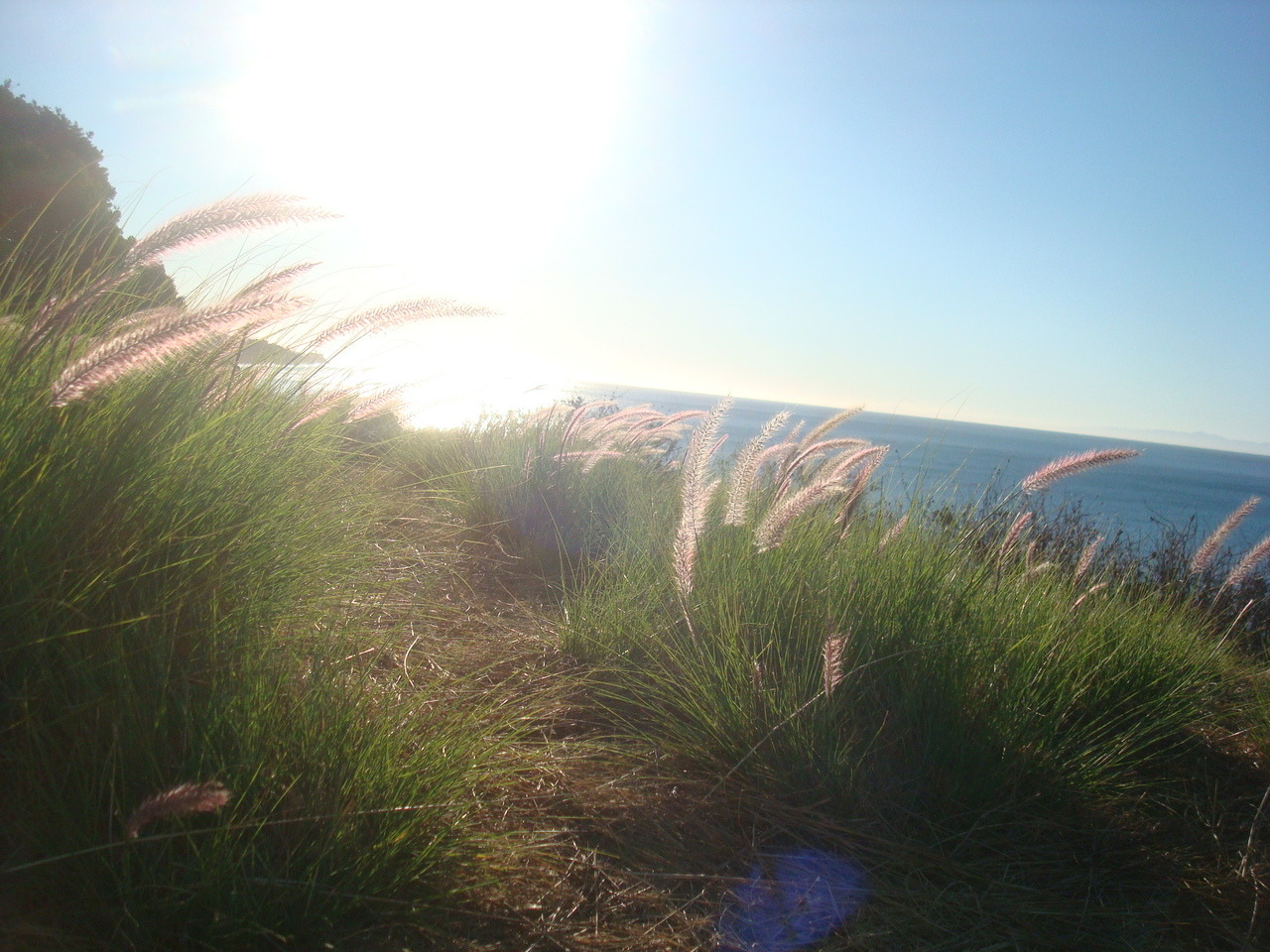
Four years ago, I celebrated becoming car-free in Los Angeles. Now, I'm writing from the Bay Area various places and am very, very attached to my car. When I was living in Downtown LA and spending most of my time there, it was easy to ditch the car and use public transit and bicycles. I still use public transit and my bicycle, when I can. But I've found that I really like camping out of my car on BLM land. And it's lovely being able to wake up to scenes like this after pulling over to sleep among eighteen-wheelers:
Vista Point, Highway 101, Santa Barbara.
I've driven between Los Angeles, Bishop, and the Bay Area many times over the last few months. It's hard for me to think about how much gas I've consumed in such a short period of time. Hundreds of gallons, I'm sure, though I get good mileage and drive conservatively. My current lifestyle includes a lot of driving, which I once tried so hard to get away from, and now, I don't really see myself getting away from it any time soon. It's harder to interact with the outdoors, be car-free, and still be very mobile. But it's possible.

If I were planning to live in one place for a long time, and commute to only a few specific places on a regular basis, it would be easier to imagine working out a way to avoid using a car for outdoors excursions. The truth is that right now, I'm not so willing to try that hard. I'm still hauling around quite a few belongings, I like being able to tuck into my home like a turtle, and I like the feeling of independence I get hurtling down highways between cities, where it can seem so desolate.
Sagebrush Campsite, Owens River Gorge, Eastern Sierra.

For now, the best course I see is in staying in places for longer stretches of time than the weeklong trips I've been taking. Where those places might be, and how far I'll have to drive to get there, are all up in the air. A few days ago I plotted out a dozen different climbing areas to visit around the western US. I've met quite a few people traveling around for a month or more (or indefinitely) for climbing. That doesn't feel like long enough, not at all. I want to take more time than that. And I want to make it sustainable for that time, both financially and environmentally, as much as possible. It's hard to imagine how that is going to work. But I'm trying.