Sunday, January 8, 2012

600 Jobs vs. 350 Families // South Central Farm News


Last November, LA's City Council voted 12-0 to allow the development of industrial warehouses at 41st & Alameda, breaking its promise to the community that any new development would include 2.6 acres of green space. I learned this after I stumbled across the 30-minute documentary Save The Farm, the story of the South Central Farmers and their fight to keep the 14 acres of land that was the largest community garden in the United States.

From 1992 to 2006, the 14 acres of South Central Farm looked like this:
Courtesy Mitch Glaser
Since the Farmers were evicted in 2006, it has looked like this:
From Google Maps
When I saw the footage of bulldozers razing the farm, pushing down fruit trees and destroying acres of crops, I cried. Watching that destruction, that waste, that disregard for the community, the brutality of the police breaking the picket line, hurt. The pain of the people who had worked that land for a dozen years was very real to me. From my own tiny parking lot garden, I've learned how much it means to coax fertility from unwelcoming ground. Furthermore, I have relationships with my neighbors that come from being out there watering and digging, and probably connections that I'm not even aware of-- a few weeks ago, three big plastic pots half-filled with dirt appeared in front of my door. I thought my roommate had brought them, only to find out from another neighbor that someone a few doors down had left them for me upon moving out. 

So it is hard to think of industrial development as having more real, lasting public good than a parcel of land where people grow things. The 600 jobs that come to the community also come with more traffic from trucks and commuters, adding pollution to to the area. Is "600 hundred jobs" really so much better than "350 families farming"? 

In the same month in which the USDA reported a record number of people receiving food stamps, LA City Council missed an opportunity to declare that a place to grow food and community is more important than a place to conduct commerce. Factories and warehouses close and decay when they are no longer profitable or useful to the owners. Poof, jobs--gone. A community garden will last as long as there are hungry people willing to tend it. LA once had the largest community garden in the nation and proved itself once again to be a city with no qualms about destroying what it has built. 

I look at the urban gardening movement in Detroit and in the world, and I look at empty lot after empty lot in Los Angeles, corralled by chain-link fences and occupied only by trash and weeds. I wonder what might grow there. I wonder how much more concrete will be poured, how much more asphalt will be spread, before we realize what a woman in the feature-length documentary The Garden said: Try planting on cement. You'll get nothing. 
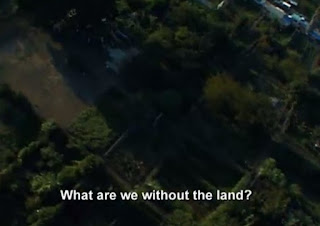
Screenshot from The Garden

"It's a pretty simple idea-- land, people, food. Happy days." - Doris Bloch

If only modern politics were that simple. I've joined the South Central Farmers' email list to try to stay updated. Please share any further information around this issue. 

Sunday, January 1, 2012

2011 in Review // The Other 1%

2011 brought a shift in my work: I applied for and was accepted into Public Allies Los Angeles, Class of 2011-2012. I now work in Central City East, at SRO Housing Corporation as a Public Ally and Case Manager in the seniors program, Project Hotel Alert. I began working there in September, and I've learned so much.

Like most people, I avoided the blocks between Los Angeles Street and Alameda and Third and Seventh-- which wsn't difficult, since this population of needy citizens and their service organizations is so well quarantined in this city. When I lived at 18th and Main, I considered the implications of gentrification that went with my living in the area. So when I found out that one of the opportunities I had as a Public Ally was to work in Central City East, I felt that I had a chance to get to know an area that, frankly, I'd been taught to (and did, to some degree) fear. And when I did get the position at SRO, it felt serendipitous.

So, for the last three months, I have spent most weekdays working at Fifth and San Julian, which some might call the "heart" of Skid Row. Union Rescue Mission and LA Mission are across the street, and Midnight Mission and LAMP Community's Frank Rice Access Center (and many other service providers) are not far, as is a park that sees much activity during the day, populated by a variety of low-low-income people, from the recently evicted, to the recently released from LAC + USC, to the recently released from prison, to military veterans, to people recently diagnosed with AIDS, to people living with addiction, to people with mental health diagnoses, to people who might have been born there, to people who will die there, to people who will leave almost as quickly as they arrive. Oftentimes, people fit into more than one of those categories.

It was hard for me to say "people who will die there." I work with seniors who live in Skid Row, some who have only been in housing for a few months, some who have been in their SROs for decades, and some who are still trying to find housing. Some are just barely 60, some are in their 80s. It is not out of the realm of possibility that one of my clients might pass away. I try not to think about that, and focus on the present, and what assistance I can be to them while we are both here.

What's wild is that in the first half of 2011, I worked just 4 blocks away in a totally different world. And that walking down Fifth street from Maple to Main is like passing between two different worlds, each equally wary of the other.

While the Occupy LA encampment was dismantled by Los Angeles police, the encampments near LA's actual Wall Street grew. During the last week of 2011, the streets where I work and on which many people live were piled with more trash than I'd seen since I started. What I'm carrying with me into 2012 is questions. The other 1%, the 1% of Americans (according to Wikipedia) who experience homelessness in a given year, are concentrated into a place that is regarded more as a quarantine zone than a neighborhood. But it is a neighborhood. It is a community. How can Central City East (Skid Row) be a healthier community? How does Los Angeles need to change in order for it be a healthier community? How does society need to change?

Thursday, December 15, 2011

Flashback: A City of Sin and Beauty // Gardena in LAPL

Gambling advertisement for the city of Gardena, 1952
source: LA Public Library
A few months ago I sat on a bus with a couple of men in their sixties who had grown up in Gardena. They described fields where they went hunting for rabbits, and farms, and a stream that's now Vermont Avenue. traci kato-kiriyama shared stories with me about her grandfather's nursery on Western Avenue. I went to LAPL's online photo collection database and typed in "Gardena," hoping to find images of this city that reflect what I've heard, and to perhaps even find a photo about the area where my building is. To my surprise, there were only about 60 results, and the photo above is one of them.

I hadn't realized that Gardena was marketed this way in the early days, as a city for gambling and "sin". Despite being near two casinos, all of my associations of Gardena are with the Japanese American community and with families. I've become accustomed to the flashing lights and jackpot blackjack ads. I don't really think about them. I have not been inside any of the buildings and I don't know a lot about how it's even legal for these gambling establishments to be here. 

I'm surprised at myself for not looking up this history as I've done before. Better hop to it before I flit off again.